Box Breathing vs 4-7-8 Breathing: Which is Best to Stop a Panic Attack?
Published Date:
When a sudden panic attack strikes, it feels as though you are losing complete control over your own body. Without warning, your heart rate spikes to over 100 beats per minute, your chest tightens as your breathing becomes shallow and rapid, and your mind races with terrifying thoughts. In these intense moments of acute anxiety, trying to “think positive thoughts” is biologically useless. Your body’s primal “fight or flight” response has hijacked your prefrontal cortex.
The fastest, most scientifically proven way to bypass your panicked mind and manually calm your nervous system is to take physical control of your respiratory system. By intentionally altering the speed and depth of your breathing, you send mechanical signals to your brain that the danger has passed. Two of the most popular and clinically researched deep breathing techniques used for anxiety management are Box Breathing and the 4-7-8 breathing technique.
While both methods are highly effective forms of deep breathing exercises for stress relief, they serve slightly different neurological purposes and suit entirely different situations. Here is the ultimate clinical comparison to help you stop a panic attack in its tracks, curated by our AI wellness journal Fısıltı.
The Physiology of a Panic Attack
To understand why these two specific breathing rhythms work, you must first understand the mechanical failure that occurs during a panic attack.
When you perceive a threat (whether it is a real physical danger or simply an overwhelming work deadline), your sympathetic nervous system dumps adrenaline and cortisol into your bloodstream. This causes you to hyperventilate, taking rapid, shallow breaths entirely in your upper chest. This restricted airflow prevents the lower lobes of your lungs from receiving adequate oxygen and causes you to exhale too much carbon dioxide. This imbalance constricts blood vessels, leading to dizziness, numbness, and the terrifying sensation that you are suffocating, which only triggers more panic.
Both Box Breathing and the 4-7-8 method work by forcing you to breathe deeply from your diaphragm (belly breathing) while manipulating the exact ratio of your inhales to exhales. This manually stimulates the vagus nerve, immediately activating your parasympathetic nervous system (the “rest and digest” state), which forces your heart rate to slow down.
Step-by-Step Breakdown: Box Breathing (The Focus Method)
Box Breathing (also known as Square Breathing or Four-Square Breathing) is famously utilized by US Navy SEALs, law enforcement officers, and elite athletes to stay calm, centered, and laser-focused in extreme high-stress combat or performance situations.
The Technique
The method is named “Box Breathing” because it consists of four equal parts, like the four sides of a square.
- Inhale: Breathe in slowly and deeply through your nose for a count of 4 seconds. Feel your stomach expand outward.
- Hold: Hold your breath, keeping your lungs full, for exactly 4 seconds. Do not clamp your throat shut; keep the airway open but suspend the breath.
- Exhale: Release the air slowly and smoothly through your mouth for 4 seconds.
- Hold: Keep your lungs completely empty and hold that emptiness for 4 seconds before beginning the next inhale.
Why It Works
The exact, equal duration of each step balances the oxygen and carbon dioxide levels in your blood perfectly. The 4-second breath holds prevent hyperventilation, while the structured counting gives your panicked mind a highly specific, logical task to focus on. Box breathing stops panic in its tracks while keeping you highly alert, awake, and ready to perform.
Step-by-Step Breakdown: The 4-7-8 Method (The Tranquilizer)
Developed by Harvard-trained physician Dr. Andrew Weil, the 4-7-8 technique is based on ancient yogic pranayama practices. Instead of balancing the breath equally, this method heavily extends the exhale, acting as a natural biological tranquilizer for the human nervous system.
The Technique
This method requires a specific mouth posture. Place the tip of your tongue against the ridge of tissue just behind your upper front teeth and keep it there through the entire exercise.
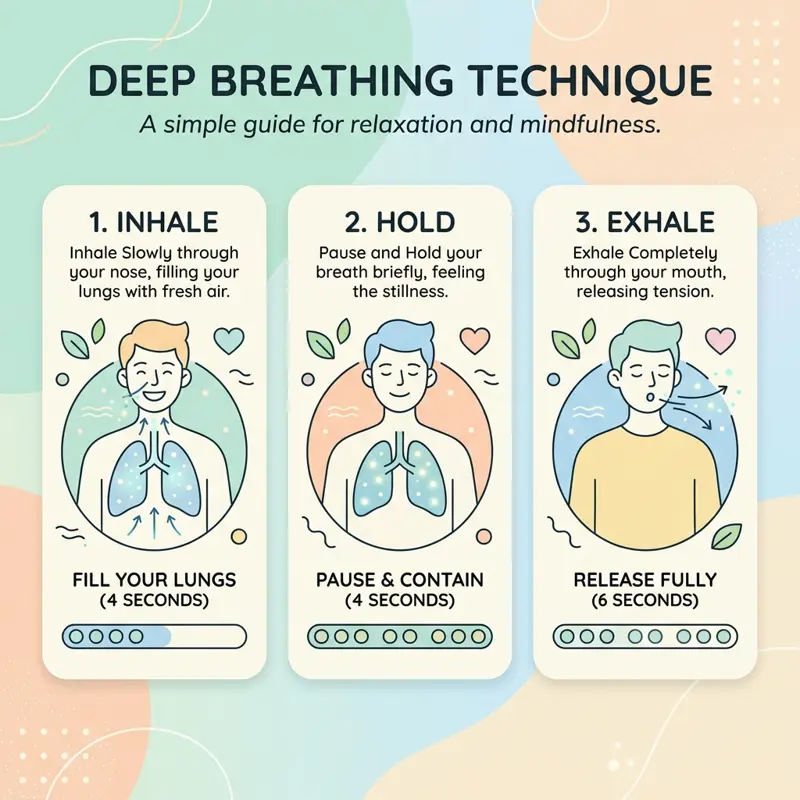
- Exhale: Part your lips slightly and exhale completely through your mouth, making a distinct “whoosh” sound.
- Inhale: Close your mouth and inhale quietly through your nose for a mental count of 4 seconds.
- Hold: Hold your breath, keeping your lungs full, for a count of 7 seconds.
- Exhale: Exhale completely through your mouth, making the “whoosh” sound again, for a count of 8 seconds.
- Repeat: Repeat this exact cycle up to 4 times.
Why It Works
The 4-7-8 method forces you to exhale for twice as long as you inhale. Physiologically, whenever you inhale, your heart rate slightly speeds up; whenever you exhale, your heart rate slightly slows down. By extending the exhale to a massive 8 seconds, you are effectively forcing your heart rate to decelerate, rapidly inducing a state of deep, heavy relaxation.
Head-to-Head Comparison: Which is Best for You?
While both methods reduce stress, choosing the right one depends entirely on the context of your panic attack and what you need to do immediately afterward.
| Feature | Box Breathing | The 4-7-8 Method |
|---|---|---|
| Primary Goal | Alert calmness and sharp focus | Deep relaxation and sleep induction |
| Best Used For | Pre-meeting anxiety, driving stress | Severe panic attacks, chronic insomnia |
| Ratio | 4 : 4 : 4 : 4 (Equal) | 4 : 7 : 8 (Extended exhale) |
| Energy Level | Leaves you awake and centered | Leaves you physically heavy and sleepy |
| Difficulty | Very easy for beginners | Holding for 7 seconds can be difficult |
- If you need to stay alert: If you feel a panic attack coming on while driving on the highway, or five minutes before you have to give a major corporate presentation, use Box Breathing. It will stop the panic without making you drowsy.
- If you need intense relaxation: If you wake up at 3:00 AM with a racing heart, or if you are safely at home experiencing a severe, paralyzing panic attack, use the 4-7-8 method. It is the strongest biological brake you can pull to stop anxiety.
Prevention: Making Breathwork a Daily Habit
Deep breathing is highly effective as an emergency intervention, but it is vastly more powerful when used as preventative daily maintenance to lower your baseline cortisol levels so panic attacks happen less frequently.
- The Transition Habit: Do not wait until you are hyperventilating to practice. Habituate deep breathing by tying it to daily transitions. For example, before you open your laptop to start the workday, do one minute of Box Breathing to center your mind.
- Pair with Journaling: Because the vocal cords are directly tied to the respiratory system, pairing breathwork with an audio diary is incredibly therapeutic. If you struggle with overcoming journaling block via voice, doing three cycles of the 4-7-8 method before you hit the record button ensures your vocal tone is steady and your emotional reflection is grounded.
- Pre-Sleep Ritual: Make the 4-7-8 method the absolute last thing you do before falling asleep. Do four cycles while lying flat in bed to signal to your brain that it is safe to shut down.
When to Seek More Help or Watch for Edge Cases
While deep breathing is universally beneficial for general stress, there are specific edge cases where these protocols can feel uncomfortable.
If you suffer from clinical Asthma or Chronic Obstructive Pulmonary Disease (COPD), forcefully holding your breath for 7 seconds (as required in the 4-7-8 method) may induce a terrifying feeling of “air hunger” or trigger a mild asthma spasm. For asthmatics, Box Breathing is generally safer because the holds are shorter.
Plus, individuals with severe Panic Disorder sometimes experience “relaxation-induced anxiety.” In these rare cases, focusing too intensely on internal bodily sensations (like counting seconds or listening to the sound of a heartbeat) can trigger hyper-vigilance rather than calm. If focusing on your breath consistently makes your panic worse, you should stop the practice immediately. Instead, use a “grounding technique” (like naming 5 things you can see in the room) to pull your attention outward, and consult a clinical psychologist for specialized guidance.
Quick Summary
- Breathing stops panic: Deep breathing bypasses the panicked brain and manually forces the nervous system to calm down.
- Box Breathing (4-4-4-4): Inhale for 4, hold for 4, exhale for 4, hold for 4.
- Use Box Breathing for focus: It balances oxygen and CO2 perfectly, stopping panic while keeping you alert for work or driving.
- The 4-7-8 Method: Inhale for 4, hold for 7, exhale for 8.
- Use 4-7-8 for deep relaxation: The extended exhale acts as a biological tranquilizer, making it perfect for severe anxiety or insomnia.
- Know your limits: If holding your breath causes asthma symptoms or increases panic, switch to gentler, continuous breathing without breath-holds.
Frequently Asked Questions
Why do I feel dizzy when I try the 4-7-8 method?
Feeling lightheaded or dizzy when you first practice the 4-7-8 method is very common. It usually happens because you are exhaling too quickly and blowing off too much carbon dioxide. Dr. Weil recommends doing no more than four cycles in a row when you first start practicing. If you feel dizzy, stop, breathe normally, and try again later.
Can I do Box Breathing for longer than 4 seconds?
Yes. Navy SEALs often practice Box Breathing at a 5-second or 6-second count as their lung capacity improves. The key to Box Breathing is not the specific number, but the equality of the four stages. Always keep the inhale, hold, exhale, and hold exactly the same length.
Do I have to make the “whoosh” sound during 4-7-8 breathing?
Yes. The “whoosh” sound is created by pursing your lips slightly, which naturally restricts the airflow. This restriction is what allows you to extend the exhale for a full 8 seconds without running out of breath too early. It also provides an auditory focus point to distract your panicked mind.
What if I can’t hold my breath for 7 seconds?
If a 7-second hold causes you to panic or gasp for air, you can speed up the counting. The absolute seconds do not matter as much as the ratio (4:7:8). You can count faster, as long as you maintain that exact ratio. As you practice daily, your lung capacity and carbon dioxide tolerance will naturally improve.
Is Box Breathing safe for children with anxiety?
Yes, Box Breathing is highly effective and safe for children. However, asking a child to visualize a “box” can sometimes be abstract. A common pediatric variation is “Star Breathing,” where the child traces the five points of a star on a piece of paper, inhaling as their finger goes up a point, and exhaling as it goes down.
Track Your Calmness and Practice Breathing with Fısıltı!
Struggling to manage your daily anxiety levels? Download the Fısıltı app. Fısıltı helps you track your emotional trends, logs your voice journal entries privately, and provides interactive guided breathing exercises like Box Breathing and 4-7-8. Download Fısıltı App Now and find your inner peace!