Evening Reflection Prompts: How Voice Journaling Promotes Sleep
Published Date:

You are exhausted. Your eyes are heavy, your body aches, and you have been longing for your bed since 3:00 PM. But the absolute second your head finally hits the pillow, your brain decides to turn on. Suddenly, you are aggressively analyzing a mildly embarrassing conversation from three years ago, outlining tomorrow’s grocery list, and worrying about your retirement fund.
Going to bed with a racing, cluttered mind is the primary psychological driver of modern insomnia. When you attempt to fall asleep while actively processing unsolved problems, your brain stays in an aggressive state of hyper-arousal. The biological solution to this nighttime panic is not scrolling through social media until you pass out. The solution is performing a structured “cognitive dump” to manually signal to your nervous system that the day is officially over.
While written journaling works, doing it in bed requires turning on a bright lamp and engaging your physical motor skills, which wakes you back up. This makes audio reflection the ultimate nighttime hack. Here is a guide to using evening voice journaling to ease nighttime overthinking, complete with reflection prompts thoughtfully curated by our AI voice diary companion Fısıltı.
The Biology of Nighttime Overthinking
To stop your mind from racing, you must understand why it happens in the first place. Throughout the day, your brain acts like a sponge, absorbing thousands of sensory inputs, conversations, and micro-stressors. During the busy workday, you do not have the time to properly process these emotions.
When you finally lie down in a dark, quiet room, the daily distractions disappear. For the first time in 16 hours, your brain has the silence it needs to finally process the backlog of emotional data it collected. This sudden processing feels like an anxiety attack, but it is actually just your brain attempting to file away unfinished business. The human brain hates “open loops” (unsolved problems). Until an open loop is closed, your brain will continually release small amounts of cortisol to keep you awake so you can solve it.
Voice journaling acts as a physical mechanism to close these loops. By speaking your worries out loud, you provide your brain with the concrete evidence it needs to believe the problem is safely stored away, allowing it to finally initiate the sleep cycle.
Step-by-Step Breakdown: Why Voice Journaling Induces Sleep
While traditional journaling is highly effective for morning pages for anxiety, voice journaling is biologically superior for nighttime use. Here is why audio works so effectively for sleep induction.
Step 1: The Screen-Free Cognitive Dump
The most dangerous thing you can do for your sleep is expose your eyes to blue light right before bed. Blue light suppresses melatonin (the sleep hormone) and tricks your brain into thinking the sun is rising.
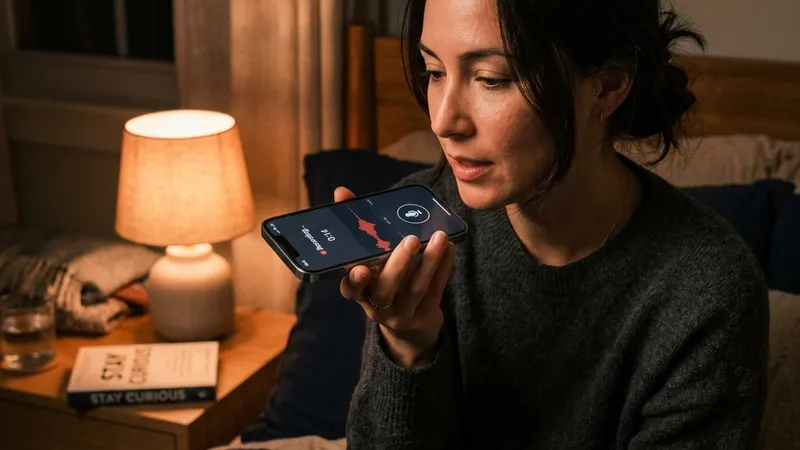
- The Voice Advantage: Traditional journaling apps require you to stare at a glowing screen to type. Voice journaling allows you to perform your emotional brain dump in total darkness. You can literally lie flat on your back, close your eyes, press a single button, and speak your mind into the dark. This screen-free venting protects your circadian rhythm while simultaneously providing the mental health benefits of voice journaling.
Step 2: Vagal Nerve Stimulation
Writing is a silent, motor-driven activity that keeps the brain highly active. Speaking out loud engages the respiratory system.
- The Voice Advantage: The physical vibration of your vocal cords combined with the deep breaths required to speak naturally stimulates the vagus nerve in your throat. This nerve is the command center for the parasympathetic nervous system. Simply by speaking softly and slowly, you manually lower your heart rate and signal to your brain that you are safe, drastically accelerating the onset of sleep.
Essential Evening Reflection Prompts for Better Sleep
If you just start complaining about your day, you run the risk of working yourself up into an angry state. To induce sleep, you need structure. Use these three specific prompts to close the mental loops of the day.
Prompt 1: The Positive Anchor
“What is one thing that went well today, no matter how small?”
- The Purpose: The human brain has a “negativity bias,” meaning it naturally remembers failures much more vividly than successes to protect you from future danger. This prompt forces your brain to scan the day for a positive data point. It does not have to be profound. “I drank a really good cup of coffee this morning” is a perfectly valid answer. Acknowledging a micro-success chemically triggers a tiny release of dopamine, replacing stress with satisfaction.
Prompt 2: The Worry Vault
“What is a minor worry I am currently holding, and can I release it until tomorrow?”
- The Purpose: This is the cognitive dump. Identify the open loop that is keeping you awake. Say it out loud: “I am worried about the presentation at 9 AM tomorrow.” By recording it into your app, you are essentially telling your brain: “I have stored this problem in a secure vault. I do not need to hold onto it anymore tonight. I give myself permission to pick it back up tomorrow.”
Prompt 3: The Gratitude Grounding
“What am I grateful for in this exact physical moment?”
- The Purpose: Anxiety is always focused on the future (what might happen). Depression is often focused on the past (what did happen). Sleep requires you to be entirely in the present moment. Force your brain into the present by being grateful for your immediate physical reality. “I am grateful that these sheets are clean. I am grateful that the room is cool. I am grateful my legs are resting.” This grounds your nervous system in physical safety.
Prevention: Creating a “Digital Sunset” Routine
A single voice journal entry will help, but turning it into a daily biological trigger requires a consistent routine. Sleep scientists recommend implementing a “Digital Sunset.”
- The One-Hour Rule: Exactly one hour before your target bedtime, turn off all overhead lights and switch to dim, warm-colored lamps. Turn off the television and stop looking at social media.
- The Audio Trigger: Make voice journaling the absolute final step of this sunset routine. Do your skincare, brush your teeth, get into bed, and turn off the lamp. Once the room is completely dark, perform your 3-minute audio reflection.
- The Pavlovian Response: If you do this consistently for 14 days, your brain will create a Pavlovian association. The physical act of speaking those three prompts into the dark will become the neurobiological trigger that immediately commands your brain to release melatonin and shut down for the night.
When to Seek More Help or Watch for Edge Cases
Evening voice journaling is highly effective for standard “racing thoughts” and mild daily anxiety. However, if your inability to sleep stems from clinical sleep disorders, this practice alone will not cure you.
If you suffer from severe Clinical Insomnia (regularly taking more than two hours to fall asleep, or constantly waking up at 3 AM unable to return to sleep), unstructured journaling might actually cause frustration if you expect it to act as a magic sleeping pill. Also, if your nighttime thoughts are dominated by severe PTSD flashbacks or clinical panic attacks, you must seek the intervention of a licensed sleep psychologist or a psychiatrist. They can provide advanced interventions like Cognitive Behavioral Therapy for Insomnia (CBT-I) or prescribe temporary sleep aids to reset your circadian rhythm while you work on the underlying trauma.
Quick Summary
- Open loops keep you awake: Your brain keeps you awake to process unsolved problems and micro-stressors from the day.
- Close the loops with speech: Voice journaling allows you to explicitly state the problems, proving to your brain that they are safely stored for tomorrow.
- Screen-free is critical: Voice recording can be done in total darkness, preventing blue light from suppressing your sleep hormones.
- Vocal vibrations calm the body: Speaking softly out loud stimulates the vagus nerve, manually slowing your heart rate.
- Use structured prompts: Anchor your brain on a micro-success, dump a worry into the “vault,” and ground yourself in physical gratitude.
- Create a Digital Sunset: Use your audio reflection as the final, predictable step of your nighttime routine to trigger a Pavlovian sleep response.
Frequently Asked Questions
Can I just think these thoughts instead of speaking them?
No. Thinking the thoughts keeps them trapped in the rumination loop within your brain. Speaking them out loud requires your brain to convert abstract anxieties into linear, structured sentences, which forces the brain to process and finalize the thought. The physical act of vocalization is what provides the cathartic release.
Should I listen to my evening recordings the next morning?
It is not necessary, but it can be helpful for the “Worry Vault” prompt. If you recorded a specific worry the night before, listening to it in the morning can remind you of what you need to tackle that day. However, for the gratitude prompts, the benefit is entirely in the act of recording them; you do not need to review them.
What if speaking out loud wakes up my partner?
If you share a bed, you do not need to speak at a normal conversational volume. You can hold your phone very close to your mouth and whisper. In fact, whispering creates a soft, breathy vocal pattern that is highly relaxing and still effectively stimulates the vagus nerve without disturbing your partner.
Does journaling work if I wake up in the middle of the night?
Yes. If you wake up at 3:00 AM with a racing mind, do not turn on the lights or look at the clock. Simply grab your phone in the dark, hit record, and dump whatever is bothering you into the audio journal. Tell yourself, “The problem is saved in the phone; I don’t need to think about it until 8:00 AM.”
How long should an evening reflection take?
Keep it very short. If you talk for 20 minutes, you risk activating your brain too much and causing wakefulness. Aim for 2 to 3 minutes maximum. Quickly answer the three prompts and then put the phone face down on your nightstand.
Calm Your Mind Tonight with Fısıltı!
Ready to declutter your mind and track your daily stress levels using voice analysis? Download the Fısıltı app. Start your voice journaling journey and get sleep-inducing reflections tonight. Download Fısıltı App Now!